On Sunday we were invited to visit the home of Suka, one of Emmett's friends. Suka received his first sacrament of communion at Mass and afterward his family asked us for lunch at their house. Suka belongs to the indigenous Shuar, who are traditional hunters and gatherers in the Amazon Rain Forest. The Shuar are distinguished as the only indigenous tribe in South America who were not conquered by the Spanish colonialists. They deserve their reputation as fierce warriors. Unlike most other indigenous people, the Shuar's assimilation to Spanish-speaking Ecuadorian and Peruvian culture began only 50-60 years ago. Different from the agrarian Saraguro of the plains, the Shuar have lived more isolated lives among smaller groups deep in the rain forest. Near Guadalupe, where we live, the Shuar mostly reside in scattered small communities surrounding Guadalupe and tend to be less economically prosperous. Understandably, the Shuar faced challenges transitioning from total self-sufficiency living in the forest to integrating with the modern culture of South American towns within the span of a few generations. Shortly after arriving in Guadalupe, we were excited to learn about the Saraguro people as they frequently share their culture through dancing, music, traditional clothing and festivals. We learned about the Shuar people through some reading on the internet and conversations with Padre Jorge and Nurse Amanda. Especially contrasted with the gregarious nature of the Saraguro, the Shuar seem more private. Considering how radical the transition has been for the Shuar to adjust to living near towns, we rarely saw any outward signs of their cultural identity. An early exposure to the Shuar villages was when we encountered their ferocious hunting dogs which protect their houses, a very different experience from the docile dogs who live in Guadalupe. Similar to our lives in the USA where Kate and I develop friendships with the parents of our children's friends, we meet people here through our children. Emmett, with his passion for soccer, truly has been an ambassador for the Landy family. Emmett and Suka first became friends through swimming in the river and playing soccer together. It was easy for me to develop a friendly relationship with Suka and his siblings because of their infectious smiles and warm dispositions. Suka and his family distinguish themselves by their athleticism and apparent vigorous health. Eventually we met Suka's parents who, not surprisingly, were warm and gracious. Last week after church we met Suka's maternal grandfather, who blessed Kate with a sign of the cross on her cheek. He lives in a remote village and came to Guadalupe to go to the medical clinic; Kate examined him the following day. Much like some elders from other cultures, he conveyed warm acceptance and joy.
A few days ago we were invited to Suka's house to celebrate his first communion. His family lives a few hundred yards in dense brush in what seems to be a marsh. Their house is made of wood planks and is elevated on stilts. A dirt courtyard communal gathering area under the house sheltered us from the torrential rains. A moat about 12 inches deep and 18 inches wide filled with water and a few ducks surrounded the courtyard. Three puppies with their mother were under the house and there was a separate cage for guinea pigs (Ecuadorian delicacy called "cuy"). Like most houses in Guadalupe, chickens roamed the yard. Suka's paternal grandparents also were there to celebrate his first communion. His grandparents live in a very small Shuar community high in the mountains. To reach their small village they travel north for 30 minutes by taxi and then ride on horseback into the forest for 2 hours. We were chatting with Suka's father and his parents when Suka's aunt and two cousins arrived. She gave the impression that she was very surprised to see us at her brother's house. This would be consistent with how private the Shuar are and how relatively few foreigners have visited Southern Ecuador's remote villages. The mystery of our presence was solved for her when she learned that Suka and Emmett are friends. She was soon smiling and touching Annalise's hair. Kate and I chatted with Suka's grandfather who is a shaman and curandero. Last year he went to Peru for 4 months to work with western medical doctors to teach them about traditional plant-based medicines. Suka's father is growing many of the medicinal plants. He showed us which plant is used to treat snake bites. Emmett told us that he often hears that Shuar people rarely need to go to the hospital. The family confirmed much of what we have heard about the traditional life of the Shuar. The grandparents told us that as children they were raised in the high mountain forest, had no formal education and wore clothes fashioned in the jungle. They were gradually introduced to the Spanish language and Catholic faith. At the dinner table, there was as much conversation in Shuar language as there was in Spanish. They seemed very devout. Suka's father shared his reverence for the land, his pride in his Shuar heritage, his desire to remain on his land and his reluctance to integrate any further with mainstream society.
We spent about 4 hours at their house and shared a full meal at their dinner table. Shortly after we arrived, Kate and I drank some fermented chonta juice from a gourd. For late lunch we had chicken, duck, rice and yucca. Emmett and I also drank some yucca juice. Suka's father made multiple toasts and prayers before and after dinner. Emmett and I realized that the yucca juice probably made us sick. Two days after our dinner, we both experienced eight hours of vomiting. Emmett and I took this in stride and held no ill feeling toward Suka and his family. Our digestive system has not fully acclimated to the local flora and parasites. All of us are accustomed to taking anti-parasite medicine every 4-6 weeks to relieve stomach cramps and pains. We have learned that adapting to our environment takes many forms. We have learned to look back at travel hardship as a rite of passage. I feel blessed that Suka and his family opened their home to us. Celebrating Suka's first communion with his family introduced us to the Shuar culture and expanded how we understand, experience and value community.
Emmett took all of the pictures below:
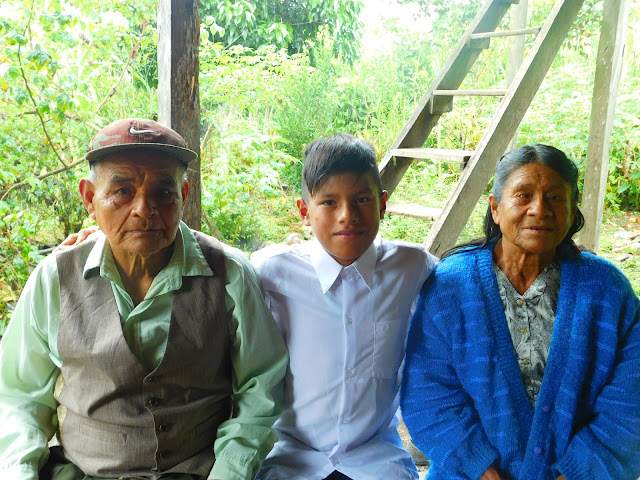 |
| Suka and his grandparents |
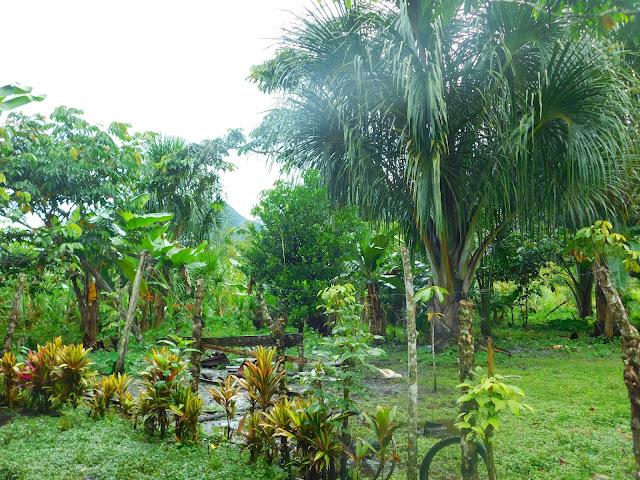 |
| Suka's yard |
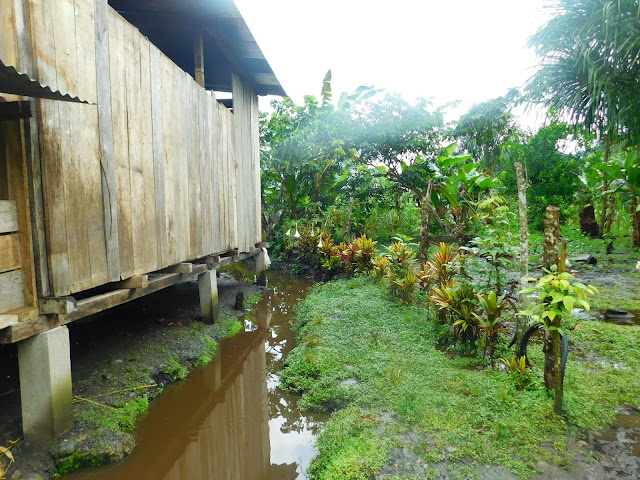 |
| Suka's house with moat around it |
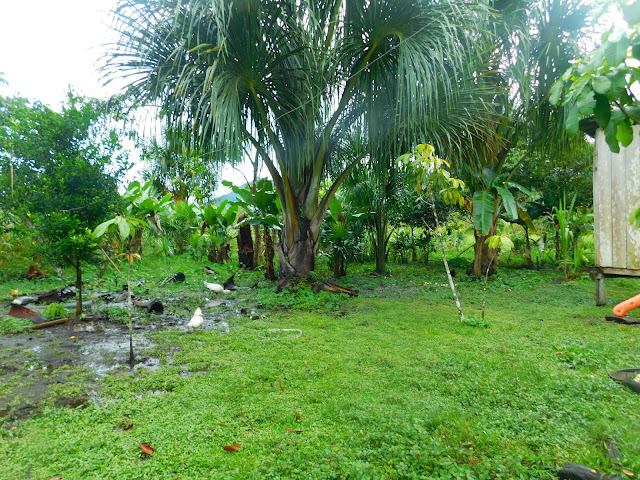 |
| yard with chickens |
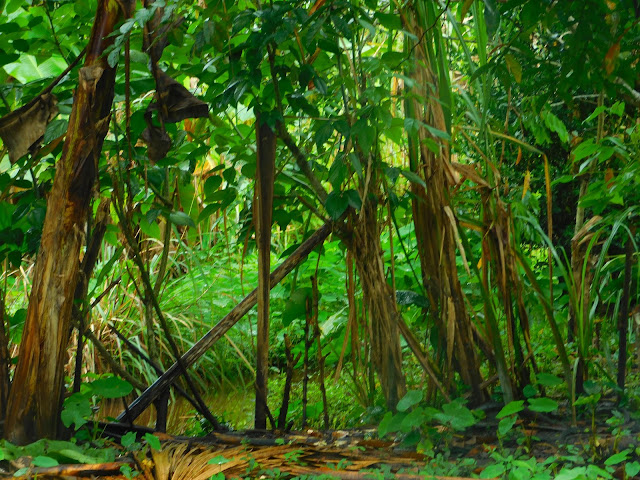 |
| forest bordering their yard |
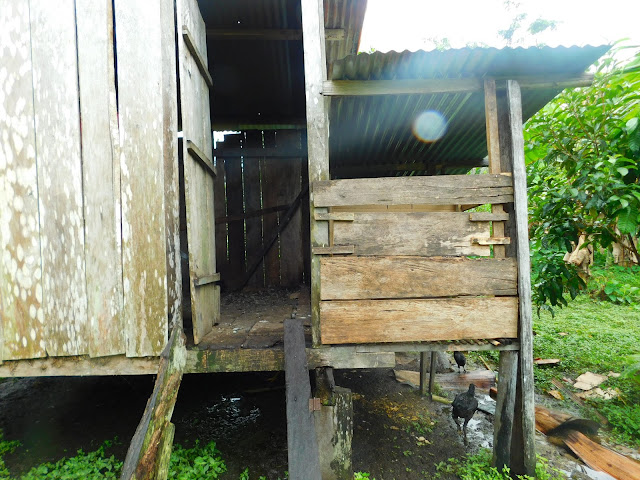 |
| Entrance to Suka family shed |
 |
Suka.
He is very adept at climbing. I have seen him climb rafters hanging upside down 40 feet over a concrete court arched roof to retrieve a soccer ball stuck in rafters.
|


