Tuesday, April 25, 2017

Emmett's birthday

We celebrated Emmett's birthday earlier this month.    His classmates sang "Happy Birthday" in English and we ate homemade cake at home.
Everyone gathered to sing Emmett Happy Birthday 

Annalise wishing Emmett a "Happy Birthday"

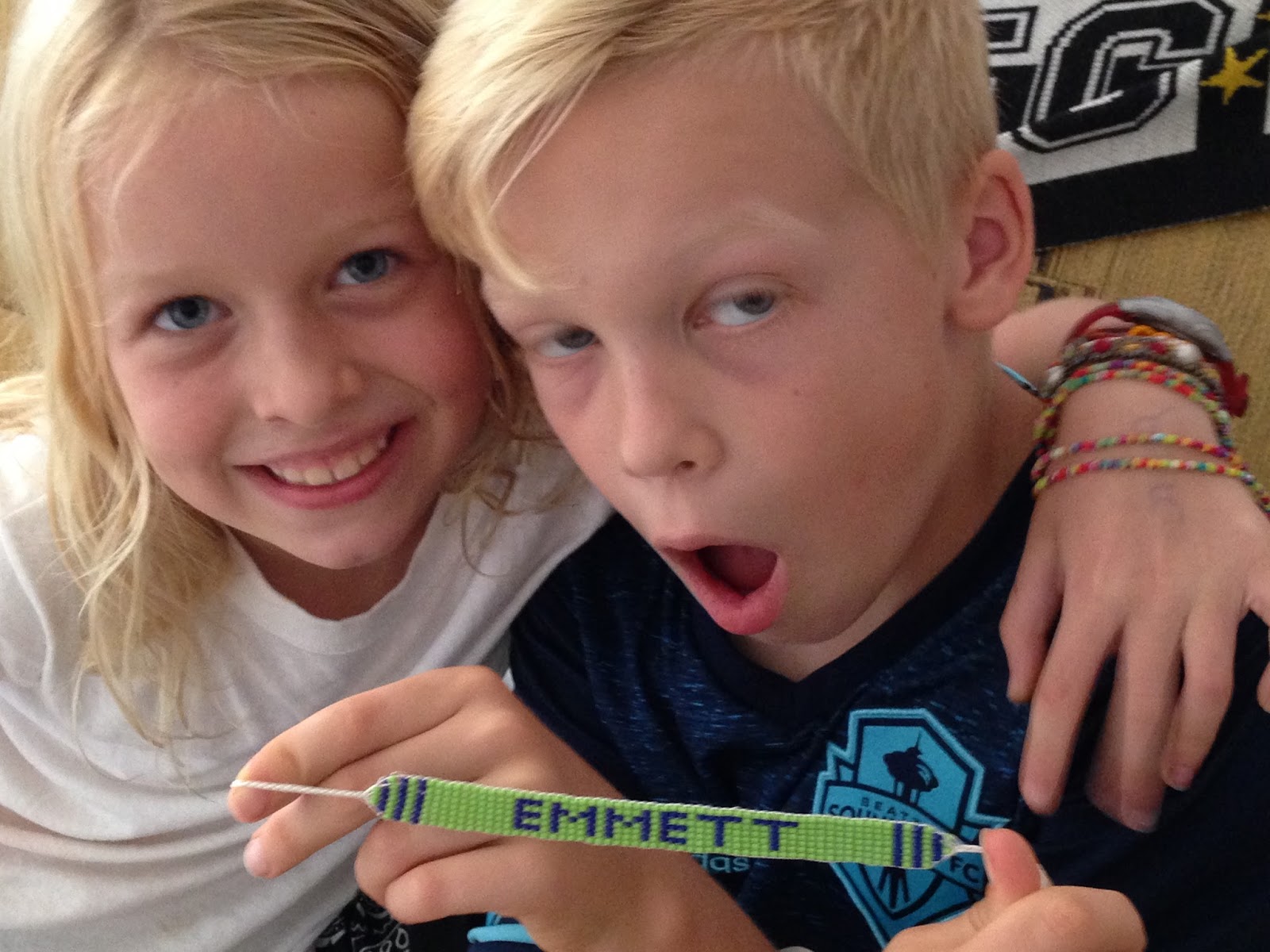
Annalise made Emmett a homemade bracelet in Sounders colors 

Itunes gift card from Grandma Landy 

Kwichua alphabet poster on their school wall    Emmett and Annalise are taught the indigenous language, Kwichua, at their school 

Sunday, April 23, 2017

Baños

Our second (and final) stop with my mom was to the town of Baños, so named because of several spots with natural hot springs.  There is an active volcano very close by (which last erupted 11 years ago) that warms the mineral springs before they come to the surface.  The town has become a real tourist destination -- people come to soak in the springs, and to do all kinds of outdoorsy activities in the surrounding mountains and rivers.


My cute kids walking down the street in Baños

A cool painted stairway depicting the nearby waterfalls

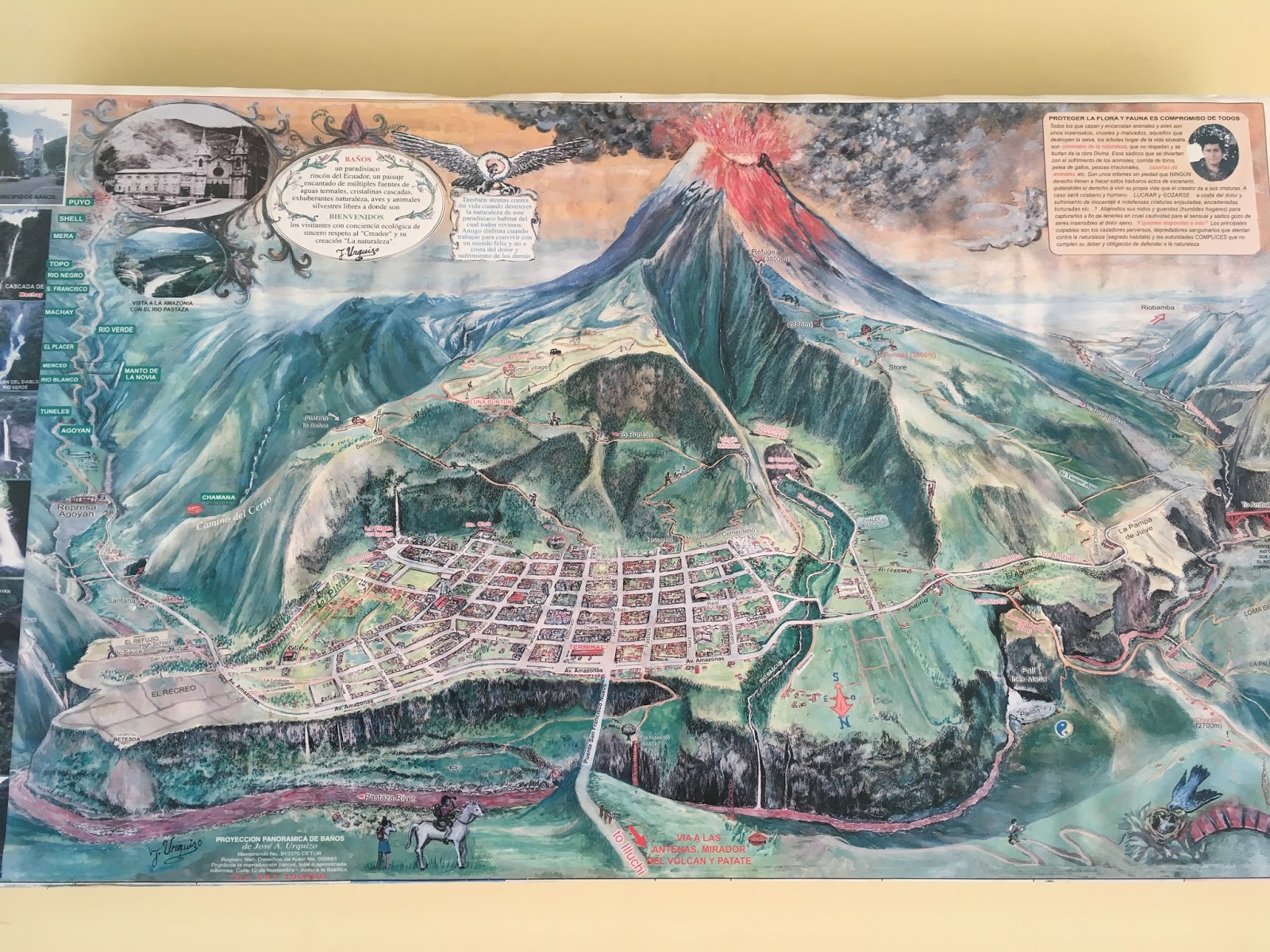
This tourist map of Baños was up in the wall at our hotel.  As we were trying to decide what to do with our few days, I was examining it and came across...


The "Animal Prison" somehow did not sound super appealing.

The big church in Baños, on the other hand, is quite beautiful.  It is dedicated to a version of Mary who is something like "Our Lady of the Holy Waters," referring to the hot springs as a sacred place. On the walls of the inside of the church are lots of paintings of miracles that Mary has performed locally over the last few hundred years, many of them having to do with people falling into the rivers and being miraculously saved.  She also protects the town from the volcano.  The church is beautifully painted and decorated, and the exterior seems to be made totally out of volcanic lava rock.

The main sanctuary 

A shot of the intricately painted ceiling 


There is an attached convent (or monastery?) with a museum, which was closed when we were there, alas. 

 A little shrine to "Our Lady of the Rosary of Holy Water" at the side of the church

Lots of people come and light candles in some petition to her

A cool flower in the garden (shot courtesy of Emmett, our budding nature photographer)

The funnest thing we did in Baños (and probably inn 2017) was zip-lining at a place called the Puntzan Canopy.  It was insanely fun.  They start you out on small, rather tame lines -- and gradually work you up to longer and amazingly scenic lines.  It was raining the whole time and totally did not care, we were having such a good time.   Even my mom got in on the fun!


Riobamba

In the week leading up to Easter, we had the opportunity to travel a little bit.  My mom, Jayn Stewart, had the week off and was able to come down and join us!  It was great to see her, and the kids were in heaven hanging out with their grandmother.

Our first stop was a mid-size city called Riobamba, which is about 3-4 hours south of Quito by bus.  It is at high altitude like Quito (roughly 9,000 ft), and has some beautiful Spanish colonial architecture.

The old colonial Cathedral in Riobamba

Closer up view of the Cathedral's facade 

Government building on the Cathedral's central plaza 

The Catherdral plaza park 

We also wandered into the Museum of Religious Art, which I believe is an old convent -- beautifully preserved and restored.  It was a really nice little oasis of quiet within the city.

Central courtyard of the museum

Annalise (with her cool new poncho) and "Amma"

We were also lucky enough to see a religious parade that came by about a block away from our hotel.  Ecuador is a very Catholic country, there is really no sense of the American ideal of "separation of Church and State," and Holy Week is a big deal here.  This was an incredibly long parade, with people dressed up as religious personages and carrying figures of Jesus and a very sad looking Mary.  It was pretty graphic -- it definitely takes the Peeps and Easter Bunny out of the Easter celebration.     This is just a small sample of the parade -- it went on and on.  It was really interesting to see, and the kind of thing you would NEVER see in the US because religion is so relegated to the margins.

One of many people dressed up as Jesus carrying the cross 

The Jesus figure in the hot pink skirt is a real person, not a statue 

There were lots of marching brass bands playing somber music 

This float is carrying a statue of Mary holding Jesus' body 


These masked figures were everywhere in the parade -- I'm not sure exactly what they are supposed to signify (death maybe?), but I have seen pictures of them in other Holy Week parades in Ecuador 

Jesus and the two sinners being marched along by Roman soldiers 

Roman soldiers 

More real guys with hands tied to crosses, and Jesus lying down on the cross in the middle 

The military also got in on the action and had their own float... and the police too

Friday, April 14, 2017

Gold mine in Nambija

Padre Jorge was kind enough to take us on another fun outing -- this time to a working gold mine in the town of Nambija, about 90 minutes away.  The two main industries in our province seem to be agriculture and gold mining.  I had always assumed that the mining was a government enterprise, but it turns out there are just lots of small individual mines up in the mountains, with widely varying safety standards.

As we were entering the town of Nambija, there were these hoses everywhere.


It turns out that every individual mine needs its own constant water supply, and they have rigged up all these hoses that branch off to the different mines.  I guess underground plumbing is too complicated and expensive...

One of Padre Jorge's fellow priests in the area, Padre René, knew of a particularly safe and well-run mine.  He called they guy in charge of it, who agreed to show us around.
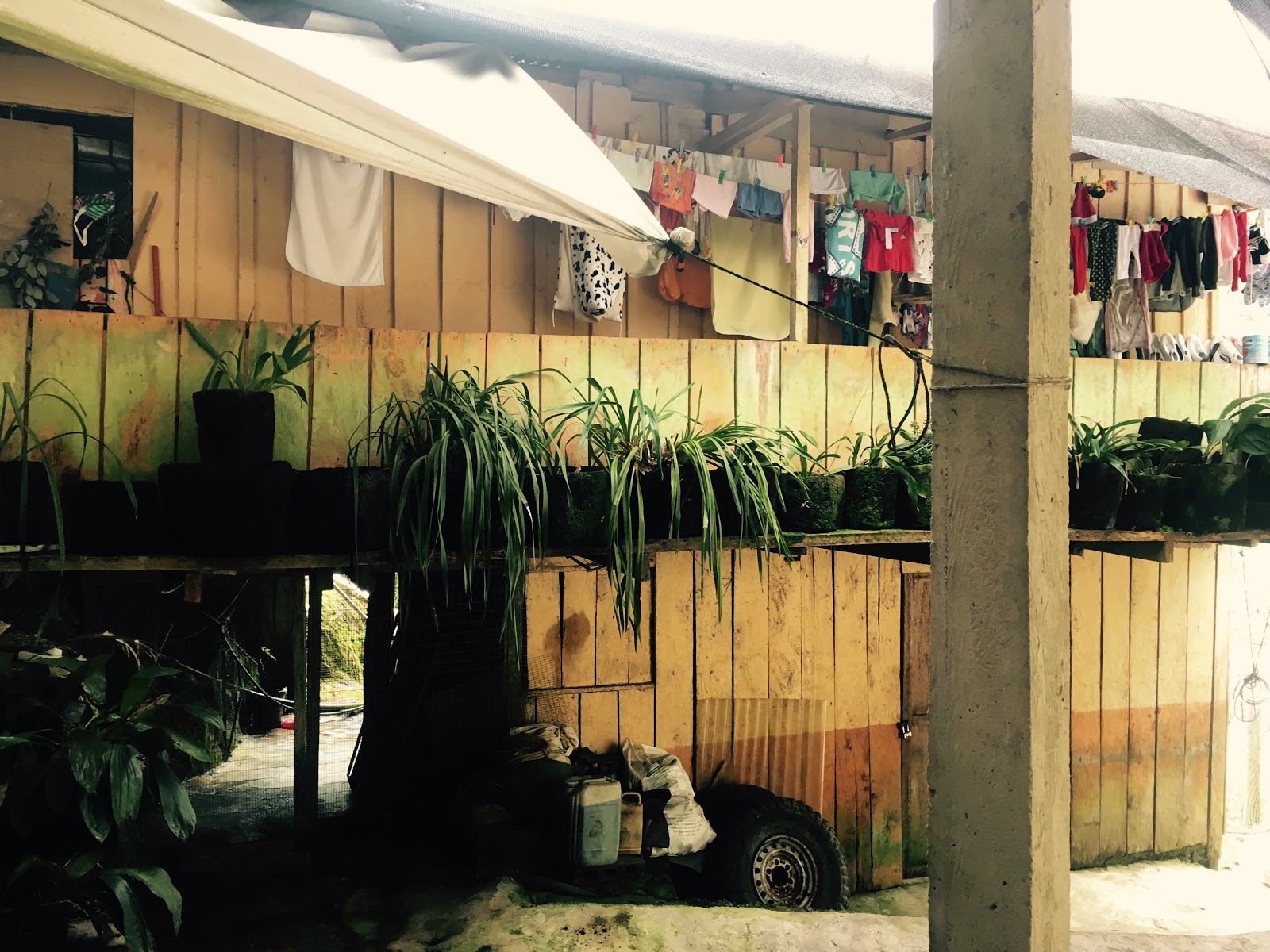
The home of the family who runs the mine -- on the premises 

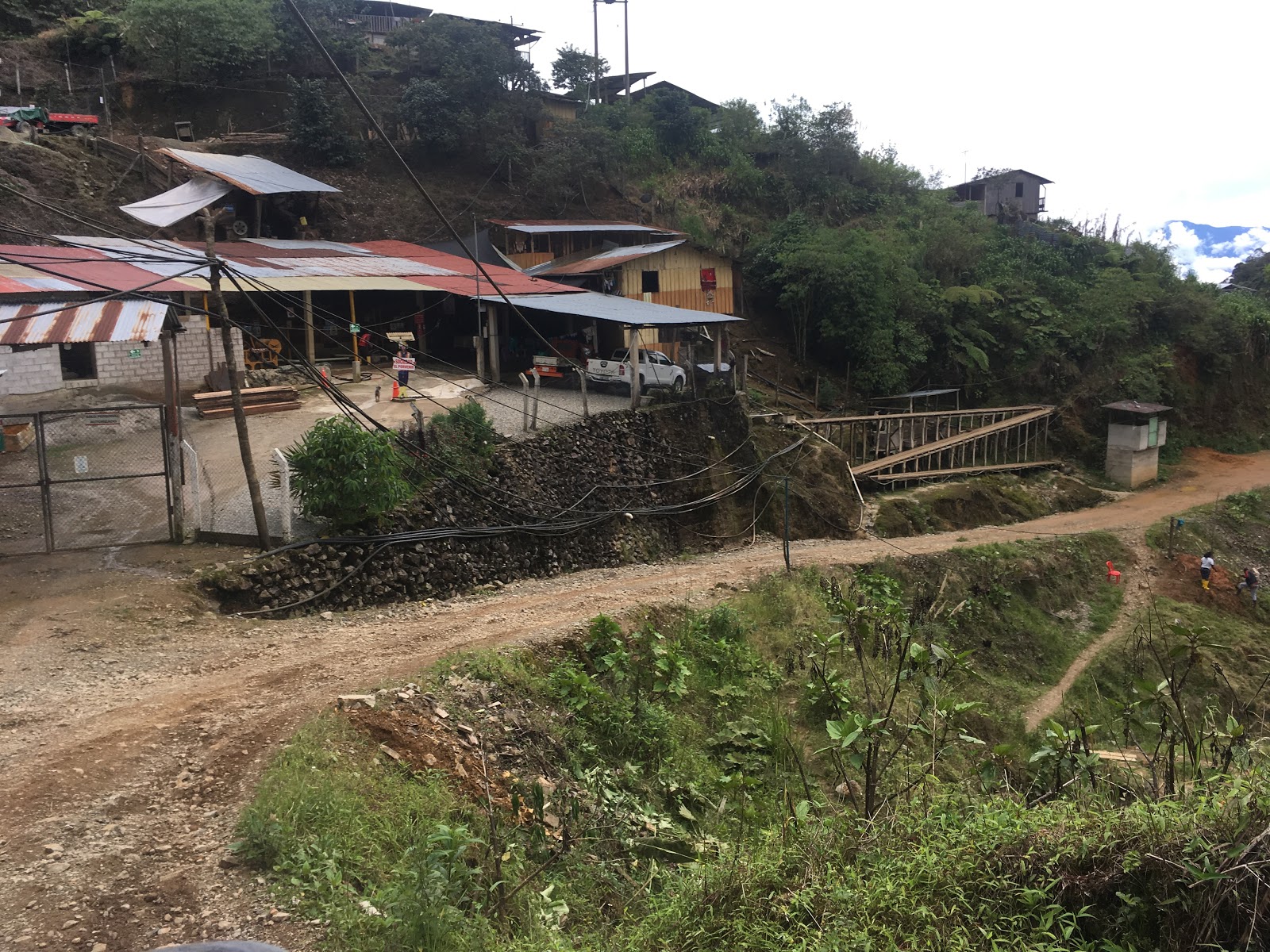
The entrance to the machinery part of the mine, where they mill the rocks and extract the gold.  The above yellow house is toward the right.


This nice man named Clever owns the mine, and has been working in mining since he was a very young man.   He pays attention to safety, and reportedly runs the safest mine around.  He led us up to the entrance of the mining tunnel. above the buildings.


This is the entrance to the tunnel, which leads deep into the mountain.   It is big enough to drive a small vehicle through, and tall enough that we tall gringos could walk pretty much upright.


It is quite dark in the tunnel, but there is safety lighting.  There are really no visible seams or chunks of gold -- evidently there used to be, but much of that has been dug out.


As a point of comparison, Clever said that this is the typical size of a mining tunnel in the area.  It is barely big enough to crouch in.   Over the months I have seen a number of miners in the clinic, many of them with back pain -- and one can understand why.  It is tough work -- but people do it because it provides a regular paycheck, which can be hard to come by.


After the rocks are dug out, they are pushed down the hill to the buildings below, where they are ground into very fine sand, and small amounts of gold are extracted from the ore using a somewhat complicated system that I don't really understand. 


 It is very hard work for not a tremendous monetary reward.  But these folks are ever hopeful that there is much more gold in these mountains than meets the eye.  It was a super interesting place to see.

Thursday, April 13, 2017

Sugar cane press

One Saturday morning we wandered up to the home of our beading teacher up in the hills -- the same family that has let Emmett ride their horse before.  The dad of the family was busy pressing sugar cane into juice -- complete with a horse tethered to a wooden log, turning the press and extracting the sugar cane juice.  It seemed like it could have been a scene from 100 years ago.

José is feeding the sugar cane into the press, and a stream of juice is coming out the right side unto a bucket.  There are several full buckets already.  He has a big pile of cane to his left, and the pressed fibers to his right.  They use the juice to make "panela," which is sort of like the brown sugar that we have in the States -- but not quite as soft.

Here is the REALLY big pile of harvested cane.  I suspect the neighbors all pool their crops and share the equipment to get the job done.

If you have never tried fresh sugar cane juice with lime, you are missing out.  Just saying.